
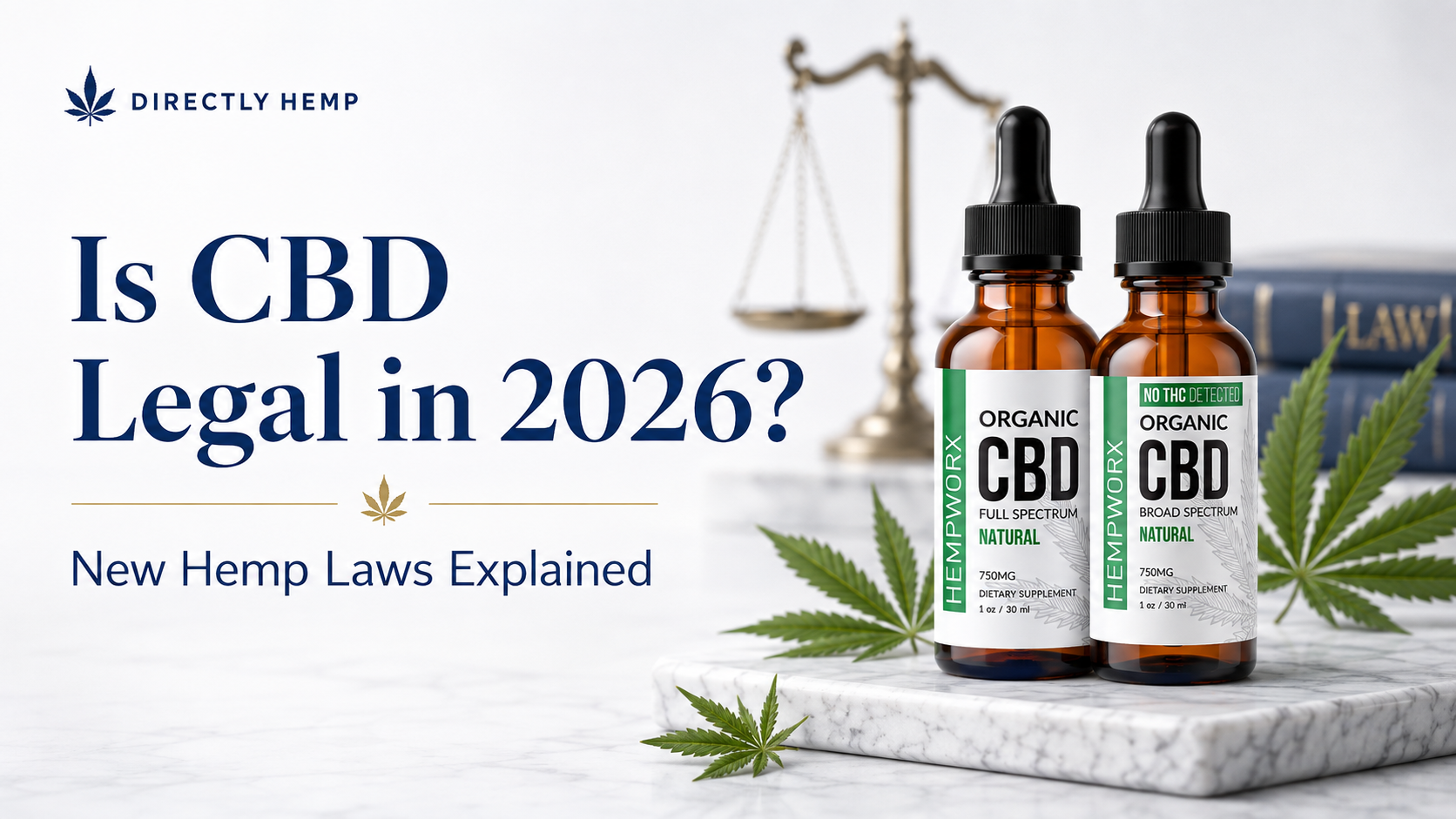
- is CBD legal
- CBD laws 2026
- new hemp law 2026
- THC free CBD
- full spectrum CBD
- HempWorx CBD
CBD laws are changing. Here is what the new federal hemp definition taking effect November 12, 2026 could mean for CBD oil, full spectrum hemp and THC free products.
Is CBD legal in the United States right now?
CBD has been sold across the United States for years, yet one of the most common questions people still ask is surprisingly simple: is CBD legal? In 2026 the answer takes a little more explaining than it used to. Hemp derived CBD is not the same thing as marijuana, and cannabidiol is generally considered non intoxicating, but the laws governing hemp products are changing and a major federal change is scheduled to take effect on November 12, 2026.
For purposes of federal controlled substance law, hemp has generally been distinguished from marijuana according to its THC content. The 2018 Farm Bill removed qualifying hemp from the federal Controlled Substances Act definition of marijuana, using a threshold of no more than 0.3% delta 9 THC by dry weight. That opened the door to a national hemp industry selling products containing compounds such as CBD.
Federal controlled substance status is only one part of the picture. States can set their own rules for hemp derived products, and the FDA retains authority over how CBD is marketed in foods, drugs and other regulated products. The FDA continues to state that, other than one approved prescription CBD drug, it has not approved ordinary consumer CBD products for treating medical conditions. So the claim that CBD is legal everywhere is too simplistic.
What is changing with hemp law in November 2026?
Congress enacted legislation in November 2025 that changes the federal statutory definition of hemp, and the new definition is scheduled to take effect November 12, 2026. Instead of looking only at delta 9 THC, the new framework considers total THC, including THCA.
The Congressional Research Service explains that the revised definition limits hemp to no more than 0.3% total THC on a dry weight basis and introduces additional restrictions on finished hemp derived cannabinoid products. One significant provision excludes certain finished hemp derived cannabinoid products containing more than 0.4 milligrams combined total THC and other cannabinoids with similar effects per container from the federal hemp definition.
That is a major change. Products excluded under the new definition may instead become subject to federal regulation as marijuana under the Controlled Substances Act once the change takes effect.
Does this mean CBD will become illegal?
No. It does not mean CBD itself is suddenly becoming illegal nationwide. CBD and THC are different cannabinoids. CBD is generally considered non intoxicating, while delta 9 THC is the primary cannabinoid associated with the high produced by marijuana.
The larger issue is what else is present in the finished product. A CBD oil containing essentially no THC presents a different regulatory question from a full spectrum hemp product containing measurable THC. That distinction is likely to become increasingly important as the new federal definition takes effect.
Full spectrum CBD vs THC free CBD
This is one reason shoppers should understand what spectrum means before ordering CBD. Full spectrum hemp extracts typically preserve a broader range of naturally occurring plant compounds, which can include trace quantities of THC. Historically, qualifying hemp products have generally operated under the 0.3% delta 9 THC threshold established under the 2018 Farm Bill framework.
The November 2026 changes introduce a much more restrictive federal standard for certain finished hemp derived cannabinoid products. Consumers using full spectrum products should pay close attention to updated product labels and Certificates of Analysis as the effective date approaches.
Broad spectrum CBD products are designed to retain multiple hemp derived compounds while removing detectable THC. Directly Hemp currently carries HempWorx Broad Spectrum THC Free CBD Oil in Natural, Cinnamon and Peppermint varieties, alongside HempWorx full spectrum oils. For consumers specifically trying to avoid THC, a verified broad spectrum THC free formulation may be the more logical category to investigate. Even so, THC free marketing should never replace laboratory verification. Look at the current Certificate of Analysis for the actual product batch whenever available.
What is a CBD Certificate of Analysis?
A Certificate of Analysis, commonly called a COA, is a laboratory report showing what was detected in a product sample. For hemp products, a useful COA helps shoppers confirm cannabinoid content rather than relying entirely on the front label. Depending on the testing performed, a COA may show concentrations of CBD, delta 9 THC, other cannabinoids and contaminants.
This matters because federal regulators have repeatedly raised concerns about the accuracy and quality of some CBD products. The FDA says its testing has found products that did not contain the amounts of CBD claimed on their labels, and it has also raised concerns about contamination, including THC. Independent testing is an important part of shopping intelligently.
Is CBD legal in all 50 states?
There is no single yes or no answer that covers every CBD product in every state. Federal law establishes the national controlled substance framework, but states can add restrictions relating to hemp derived products, product types, age limits, THC levels, manufacturing and retail sales.
A product that qualifies under federal hemp law can still face different restrictions depending on the state where it is sold. Check the current rules in your own state, especially when buying gummies, beverages or products containing measurable THC. And because the federal hemp definition changes in November 2026, older articles describing CBD law based solely on the 2018 Farm Bill may become outdated.
What about CBD gummies?
CBD gummies require another distinction. The federal Controlled Substances Act and FDA regulation are not the same thing. Although qualifying hemp may fall outside the federal definition of marijuana, the FDA currently maintains that CBD cannot lawfully be marketed simply by adding it to conventional food or by labeling ordinary CBD products as dietary supplements under federal food and drug law.
Meanwhile, state approaches to consumable hemp products vary considerably. That is why a statement such as CBD gummies are federally legal everywhere can be misleading without explaining which body of law is being discussed.
Does CBD get you high?
CBD itself is not generally considered intoxicating in the way THC is. The Congressional Research Service describes CBD as generally non psychoactive, while identifying delta 9 THC as the primary psychoactive compound in cannabis.
Shoppers should still look carefully at the cannabinoid profile of a finished product. A bottle labeled hemp or CBD does not automatically tell you how much THC is present. The laboratory report is more informative.
Can CBD make you fail a drug test?
Standard federal workplace drug testing focuses on marijuana and THC markers rather than CBD itself. SAMHSA states that federal urine testing reports the THC metabolite THCC, while oral fluid testing reports THC.
The Department of Transportation similarly warns safety sensitive workers that although DOT testing is for marijuana rather than CBD, CBD products may contain THC, and CBD use is not accepted as an explanation for a confirmed marijuana positive test. No retailer should promise that a CBD product guarantees you will pass a drug test. If workplace testing matters to you, read our guide on CBD and drug testing linked below.
What should CBD shoppers look for in 2026?
The smartest way to shop for hemp products is to look beyond the marketing on the front of the bottle. Check what type of extract you are buying and determine whether it is full spectrum or broad spectrum. Review the current laboratory results and look at the actual THC measurement. Buy from a source that clearly identifies its products and provides meaningful product information.
As November 12 approaches, pay close attention to updated manufacturer information regarding compliance with the new federal hemp definition.
DirectlyHemp.com currently offers HempWorx full spectrum CBD oils as well as Broad Spectrum THC Free CBD Oil in Natural, Cinnamon and Peppermint. The site also carries HempWorx CBDA Broad Spectrum and other hemp products. For someone specifically looking to avoid THC, start by exploring the broad spectrum THC free category and reviewing the latest product information and laboratory documentation before buying.
The bottom line: is CBD legal in 2026?
CBD has not simply become illegal in 2026, but the legal landscape surrounding hemp derived cannabinoid products is changing substantially. The important date is November 12, 2026, when the new federal statutory definition of hemp is scheduled to take effect, including a total THC standard and new restrictions affecting certain finished hemp derived cannabinoid products.
For consumers the practical lesson is simple: know what is actually in the product you are buying. CBD and THC are not the same thing. Full spectrum and THC free broad spectrum are not the same thing. And a vague hemp label is not a substitute for current laboratory information. As the laws change, DirectlyHemp.com will continue updating its educational information to help shoppers understand the products they choose.
Frequently asked questions about CBD legality
Is CBD federally legal in 2026? Qualifying hemp derived CBD can fall outside the federal Controlled Substances Act definition of marijuana, but that does not mean every CBD product or use is lawful under every federal or state regulatory framework. A new federal hemp definition is scheduled to take effect November 12, 2026.
Is THC free CBD legal? THC free CBD avoids many of the issues associated specifically with THC content, but product legality can still depend on the formulation, how the product is marketed and applicable state and federal regulations.
What happens to hemp on November 12, 2026? A revised federal definition of hemp takes effect. It moves toward total THC rather than only delta 9 THC and excludes certain finished hemp cannabinoid products exceeding specified cannabinoid limits.
Is full spectrum CBD still legal? The answer depends on the product cannabinoid content and applicable federal and state rules. Because the federal definition changes in November 2026, full spectrum manufacturers and retailers will need to evaluate products under the new requirements.
Does CBD contain THC? CBD itself is a cannabinoid separate from THC. Finished full spectrum CBD products can contain THC, while broad spectrum THC free products are designed to remove detectable THC.
Is CBD legal in every state? State hemp and CBD rules vary, so check current regulations where you live rather than relying solely on federal law.
Keep reading on our site
Sources and further reading
This article is for general educational purposes and is not legal or medical advice. Federal and state hemp laws can change. Check applicable laws in your jurisdiction and consult an appropriate professional when necessary. Directly Hemp is an authorized seller of HempWorx products. These statements have not been evaluated by the Food and Drug Administration. These products are not intended to diagnose, treat, cure or prevent any disease.