
- CBD travel
- TSA CBD rules
- flying with CBD
- CBD oil
- CBD gummies
- HempWorx
- hemp travel
- full spectrum CBD
- THC free CBD
- CBD laws
Can you take CBD oil or gummies on a plane? Our updated 2026 guide explains TSA rules, carry on liquid limits, full spectrum CBD, international travel and an important federal hemp law change coming November 12.
Can you take CBD on a plane in 2026?
Packing for a flight and wondering whether your CBD oil or gummies can go through airport security? For most domestic U.S. travelers the short answer is yes. Federally compliant hemp derived CBD can generally travel with you, but there are several rules you need to understand before putting that bottle in your carry on.
CBD laws, TSA screening rules, liquid restrictions, state laws and international customs rules are not all the same thing. And in 2026, federal hemp law is changing again. Here is what travelers should know before heading to the airport.
TSA's current guidance lists cannabis related products under special instructions for both carry on and checked baggage. TSA also states that its security officers are focused on aviation safety rather than actively searching for illegal drugs. If an apparently illegal substance is discovered during screening, however, TSA can refer the matter to law enforcement.
For hemp derived CBD, the federal standard in effect as of August 2026 continues to distinguish hemp from marijuana based primarily on a maximum 0.3 percent delta 9 THC concentration on a dry weight basis. That makes properly compliant CBD very different from recreational marijuana or high THC edibles. Still, travelers should never assume that the words CBD or hemp automatically make every product legal. Always know what is actually in the product you are carrying.
Can you bring CBD oil in your carry on?
Yes, but CBD oil also has to comply with TSA's normal liquids rules. TSA's 3 1 1 rule allows liquids, gels, aerosols, creams and pastes in containers of 3.4 ounces or 100 milliliters or less in carry on baggage. The containers must fit within the passenger's permitted quart size liquids bag.
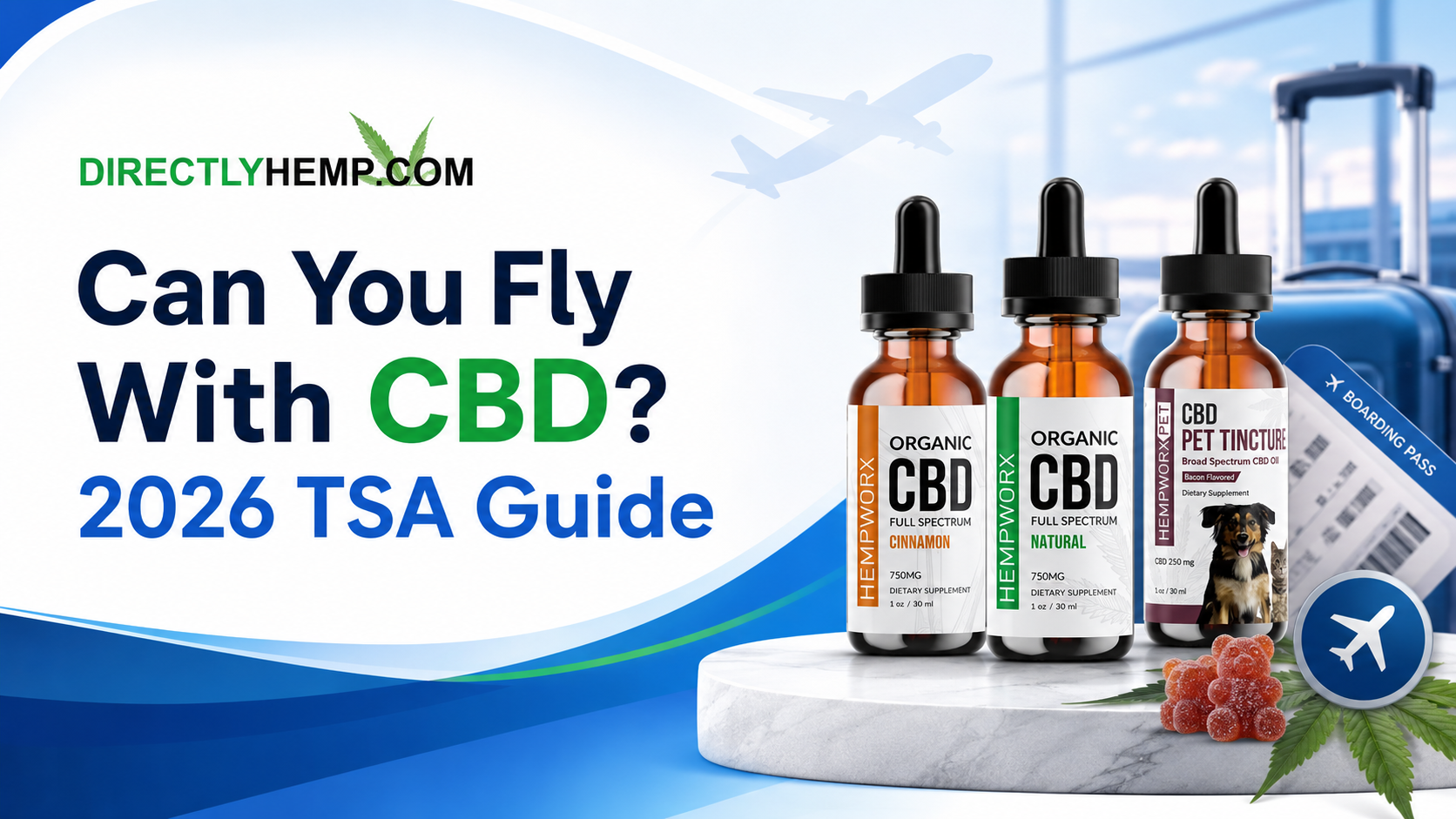
Most standard CBD tinctures are much smaller than that. For example, a typical HempWorx CBD oil bottle sold through Directly Hemp is 30 mL, placing the bottle well below TSA's 100 mL carry on limit. That does not determine whether the CBD itself is legally compliant, but it means the bottle size should not create a separate liquids problem.
Smart packing tip. Keep CBD oil in its original labeled bottle, tightly closed, inside your liquids bag, with the product's Certificate of Analysis available on your phone if possible. TSA does not require you to carry a laboratory report for ordinary CBD, but having clear product information can make it easier to identify what you are carrying if questions arise.
Can you fly with CBD gummies?
CBD gummies can be simpler to pack because they are solid rather than liquid. TSA permits solid foods in both carry on and checked baggage, although any food can be subject to additional screening. The bigger issue is not whether the gummies are solid. It is what cannabinoids they contain.
Hemp derived CBD gummies and marijuana derived THC gummies are not automatically treated the same way under federal law. Read the package carefully and know whether the product is full spectrum, broad spectrum, THC free or contains measurable THC.
What about CBD cream?
CBD cream is generally treated like other creams for security screening purposes. If you carry it onto the aircraft, the container must normally comply with the 3.4 ounce 100 mL liquids, gels and creams limit. Larger containers should generally go into checked baggage unless another TSA exception applies.
The same advice applies here. Keep the HempWorx Relief Cream in its original container rather than transferring it into an unlabeled travel jar. Original packaging helps an agent identify the product quickly if it is pulled aside for a closer look.
Full spectrum CBD vs THC free CBD when flying
This distinction becomes especially important when traveling. Full spectrum CBD contains CBD along with other naturally occurring hemp compounds and may contain legally permitted trace quantities of THC. As of August 2026, federal hemp law still uses the 0.3 percent delta 9 THC dry weight standard established under the 2018 Farm Bill.
Broad spectrum products are formulated to retain multiple hemp derived compounds while removing detectable THC. If minimizing THC exposure is important to you, a broad spectrum product can be easier to travel with from a practical standpoint because there is less ambiguity around trace THC. However, THC free labeling should never be treated as a legal guarantee. Check the actual product information and available lab results.
You can compare HempWorx full spectrum and THC free CBD oils in the Directly Hemp CBD oil guide before choosing a formulation that fits how you travel.
Does TSA search your bag for CBD?
TSA says its screening procedures are designed to identify potential threats to aircraft and passengers, not to search specifically for illegal drugs. That does not mean illegal substances are ignored. If TSA discovers something that appears to violate the law during normal screening, it can refer the situation to local, state or federal law enforcement.
That is another reason to carry clearly labeled, legitimate products rather than loose gummies, unmarked oils or products removed from their original packaging.
Can you put CBD in checked luggage?
CBD products may also be placed in checked baggage where permitted. For liquids, checked luggage avoids the 3.4 ounce carry on restriction. But there are practical reasons you may prefer carrying a small legal CBD tincture in your carry on instead.
Checked bags can be delayed or lost. Extreme heat can affect some products. Original packaging and product information stay with you when you keep it close. You also have easier access to the product when you arrive. The legality of the product itself still matters regardless of which bag you choose.
What about flying between two states where CBD is legal?
Do not assume that because CBD is sold in both states, every cannabinoid product is treated identically. States can establish their own restrictions on hemp derived consumer products. Before traveling, particularly with products containing measurable THC or newer cannabinoids, check the current laws of both your departure state and destination.
For straightforward CBD products, choosing clearly labeled hemp derived products from an established manufacturer like HempWorx is far preferable to traveling with an unidentified tincture or edible.
Can you fly internationally with CBD?
This is where the answer changes dramatically. TSA rules only govern the U.S. security screening process. They do not make CBD legal in another country.
The U.S. State Department warns travelers that they must follow the laws of every country they enter or even transit through. Something legal in the United States can still result in fines, detention or arrest abroad. Some countries specifically prohibit CBD.
For example, current U.S. State Department information warns that CBD products are prohibited or heavily restricted in destinations including the United Arab Emirates, Indonesia, Malaysia, the Cayman Islands and Panama. Some of these countries treat CBD products similarly to marijuana products under their drug laws.
The safest rule for international travel. Before packing CBD, check the laws of your destination, check every country where you have a connecting flight, check that country's customs or health authority, and contact the country's embassy or consulate if the rule is unclear. Do not assume a U.S. hemp label protects you overseas. If you cannot verify that CBD is permitted, leave it at home.
Important. Federal hemp rules change November 12, 2026
There is another reason a 2026 travel guide needs a date on it. Congress enacted a new federal definition of hemp that is scheduled to become effective on November 12, 2026.
The new law moves away from considering only delta 9 THC and instead uses total THC, including THCA. It also establishes new restrictions for final hemp derived cannabinoid products, including a limit involving total THC and other cannabinoids with similar effects per container.
That means a product that qualifies as federally legal hemp under the rules in effect today may need to be evaluated differently after November 12. If you are reading this article after November 12, 2026, check the latest federal and TSA guidance before traveling. Directly Hemp will update this guide as federal rules are implemented.
CBD travel checklist
Before leaving for the airport, check the THC content of your CBD product. Keep products in original packaging and use clearly labeled HempWorx products rather than unmarked containers. Keep CBD oil under 3.4 ounces or 100 mL in carry on baggage.
Remember that gummies are solid foods but cannabinoid laws still apply. Consider keeping the Certificate of Analysis available. Check the laws of your destination and your international connection points. Never assume marijuana and hemp derived CBD follow the same rules. Recheck federal hemp rules for travel after November 12, 2026.
Can you fly with HempWorx CBD?
When traveling domestically, start by knowing exactly which HempWorx formula you have. Directly Hemp offers both full spectrum CBD products and products formulated without detectable THC.
If you are comparing options, visit the HempWorx CBD Learning Center for straightforward explanations of CBD oil, full spectrum vs THC free CBD, CBDA, gummies, Relief Cream and pet CBD. You can also read our guide to CBD and drug testing if THC exposure is a concern before a flight.
Frequently asked questions
Can I bring CBD oil through TSA? A federally compliant CBD product may generally travel through U.S. airport security, subject to current TSA and federal rules. Liquid CBD in carry on baggage must also comply with the 3.4 ounce 100 mL liquids limit.
Can I take CBD gummies on an airplane? Solid gummies are permitted through TSA screening as food, but the cannabinoids inside the gummies still need to comply with applicable laws.
Should CBD go in my carry on or checked bag? Either may be possible for a compliant product. A small CBD tincture under 100 mL can fit within the carry on liquids rules.
Can I fly with full spectrum CBD? Full spectrum CBD may contain trace THC. Under the federal hemp rules currently in effect in August 2026, qualifying hemp contains no more than 0.3 percent delta 9 THC on a dry weight basis. Federal hemp rules are scheduled to change November 12, 2026.
Can I fly internationally with CBD? Do not assume so. CBD is prohibited in some countries even when it is legally purchased in the United States. Check your destination and all transit country laws before traveling.
The bottom line
So, can you fly with CBD in 2026? For domestic U.S. travel, federally compliant hemp derived CBD can generally be transported, but TSA rules, product composition, liquid limits and state laws all matter.
CBD oil in a carry on must follow TSA's 3.4 ounce liquids rule. Gummies are treated as solid food for screening purposes. And international travel deserves much more caution because some countries prohibit CBD entirely.
Most importantly, 2026 is a transition year for federal hemp law. New federal rules become effective November 12, so anyone traveling later in the year should verify the current requirements before packing a CBD product. Travel informed, keep your products clearly labeled, and when in doubt, check before you fly.
These statements have not been evaluated by the Food and Drug Administration. These products are not intended to diagnose, treat, cure or prevent any disease.
Keep reading on our site
- Shop HempWorx CBD oil, full spectrum and THC free
- HempWorx 750mg full spectrum CBD oil, natural
- HempWorx THC free broad spectrum CBD oil, peppermint
- HempWorx CBD gummies, 750mg assorted flavours
- HempWorx CBD Relief Cream
- HempWorx CBD Learning Center
- HempWorx FAQ
- Shop HempWorx products
- CBD and drug testing, what you need to know
- How long does CBD stay in your system?
Sources and further reading
These statements have not been evaluated by the Food and Drug Administration. These products are not intended to diagnose, treat, cure or prevent any disease.