
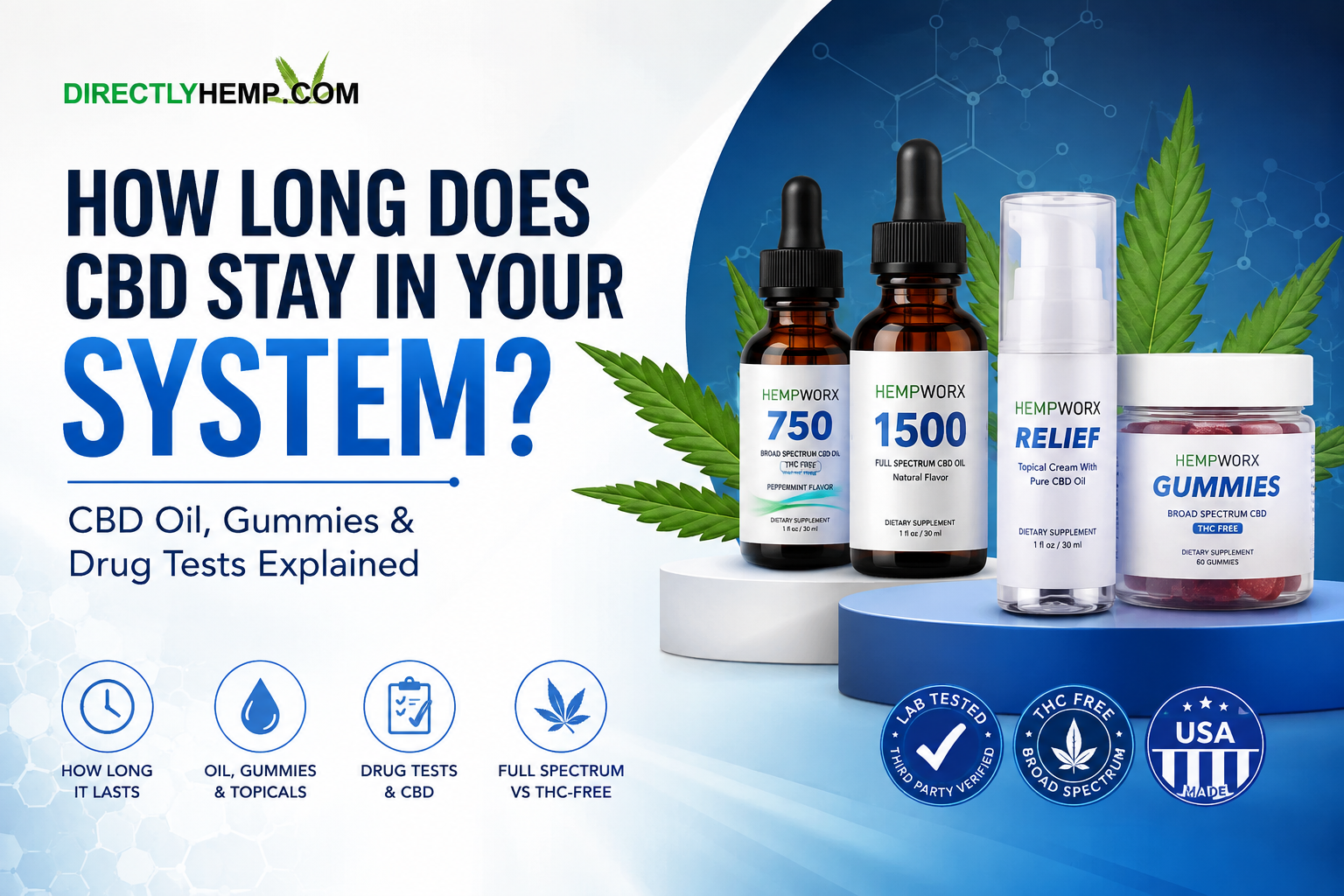
- how long does cbd stay in your system
- cbd drug test
- thc free cbd
- full spectrum cbd
- cbd gummies
- hempworx cbd oil
How long does CBD stay in your system, and can CBD cause a positive drug test? Learn how CBD oil, gummies, full spectrum and THC free products differ and what actually matters when testing for THC.
How long does CBD stay in your system?
If you use CBD oil, gummies or another hemp derived product, sooner or later the question comes up: how long does CBD stay in your system? It matters most to people with a workplace drug test coming up, anyone using CBD daily, and shoppers deciding between full spectrum and THC free formulas.
There is no single number that applies to everyone. CBD does not vanish the moment its noticeable effects fade. Once it reaches the bloodstream the body clears it gradually, and research shows wide variation in how long that takes depending on the amount used, the formulation, the delivery method, and whether the product was used once or repeatedly.
A half life describes roughly how long the body needs to clear half of an absorbed substance, not how long until it is completely gone. Published half lives for CBD range from hours to several days under different conditions, and with repeated oral use CBD tends to linger longer than after an occasional single serving. That is why claims such as CBD is gone after 24 or 48 hours are not scientifically reliable.
What determines how long CBD stays in your body
How much you use is the first factor. A larger serving simply gives the body more to process. Milligram strength on the label describes the whole bottle, so a 750 mg bottle of HempWorx CBD oil is not the amount taken in one serving.
Frequency is the second. Someone taking CBD once may clear it differently from someone dosing every morning and night, because CBD and its metabolites can accumulate to some degree with regular use.
Product type matters too. Oils and tinctures, gummies, capsules, oral sprays, topical creams and pet formulas are all absorbed differently. So does your own metabolism, including body composition, age, liver function, genetics, diet and any medications you take. Two people using the same serving of the same product can clear it at different rates.
Food changes the picture as well. Studies have found that taking oral CBD with a meal, particularly one containing fat, increases how much CBD reaches the bloodstream, which in turn affects how the body handles it afterwards.
How long does CBD oil stay in your system?
CBD oils and tinctures are usually swallowed or held under the tongue according to the label directions. Once absorbed, CBD circulates and is mainly metabolised by the liver.
There is no exact hour or day count after which CBD oil is guaranteed to be absent in every person. Occasional use generally leaves less accumulated CBD than daily use, and regular use can stretch the elimination window.
If drug testing is your real concern, though, the more useful question is not how long CBD stays in your body. It is whether the product you chose contains THC.
How long do CBD gummies stay in your system?
CBD gummies travel through the digestive system before the cannabinoid is absorbed, so their absorption pattern differs from oil held under the tongue. There is still no universal detection window.
Serving size, how often you use them, metabolism, body composition, what you have eaten and the specific formulation all influence absorption and clearance. The same testing consideration applies as with oil: if a gummy contains trace THC, repeated use means more THC exposure than a THC free formula would give you.
Does CBD show up on a drug test?
CBD itself is generally not what standard workplace marijuana screens are built to find. Federal urine testing programmes look for a metabolite associated with THC, and pure CBD is a chemically different compound.
The complication is that not every CBD product contains only CBD. Full spectrum hemp products keep a range of naturally occurring hemp compounds and may contain legally permitted trace THC. That trace amount may not be intoxicating, but repeated use can still increase THC exposure, which matters for anyone subject to workplace, athletic, military, transportation or probation testing.
So can full spectrum CBD cause a positive result? It is possible. The outcome depends on THC concentration, serving size, how often and how long you use the product, your metabolism, the type of test and the laboratory threshold. A legal hemp product is not an automatic guarantee of a negative result.
What about THC free or broad spectrum CBD?
Broad spectrum CBD is formulated to keep multiple hemp derived compounds while removing THC. You will also see products described as THC free or as containing no detectable THC.
For shoppers specifically trying to minimise THC exposure, a reputable broad spectrum product usually makes more sense than a full spectrum one. Even so, no responsible seller should promise that any product guarantees a negative drug test. Product quality, laboratory detection limits, manufacturing consistency, test sensitivity and individual circumstances all play a part.
If passing a test is essential to your job or another important obligation, the safest step is to speak with the testing authority or a healthcare professional before using any cannabinoid product.
Full spectrum vs THC free CBD: which should you choose?
Full spectrum formulas retain multiple naturally occurring hemp compounds and may include trace THC within applicable hemp requirements. They appeal to people who specifically want a whole hemp formulation.
Broad spectrum and THC free formulas keep a range of hemp compounds while being processed to remove THC, which suits anyone who wants CBD without the THC exposure.
At Directly Hemp you can compare HempWorx full spectrum and THC free CBD oil side by side, along with CBD gummies and daily sprays, before deciding which formulation fits your situation.
How long does CBD stay in urine?
There is no simple, scientifically established urine detection window for consumer CBD products that applies to everyone. More to the point, standard marijuana urine testing is concerned with THC metabolites rather than CBD.
If you use a full spectrum product, the potential detection issue is the THC in the formulation, not the presence of CBD. THC detection periods vary substantially with how much and how often someone is exposed, so an occasional user may see a very different outcome from someone consuming trace THC daily for months.
Does CBD cream stay in your system?
Topical CBD is applied to the skin rather than swallowed. Traditional creams such as HempWorx CBD Relief Cream are intended for localised external use, and their absorption characteristics differ from oral products.
Topical and transdermal are not the same thing, however. Some formulations are designed specifically to carry ingredients through the skin more effectively. If testing is a concern, read the exact ingredients and laboratory information for the product rather than assuming every topical behaves the same way.
How to tell whether a CBD product contains THC
Look past the front label. Check the spectrum type first: full spectrum, broad spectrum or isolate. Then check what the manufacturer states about THC, whether it is present, removed or not detected.
Ask for a Certificate of Analysis. Reputable manufacturers publish independent laboratory results showing cannabinoid levels. Check the CBD concentration in the bottle and per serving, and read the full ingredient list so you know what else is in the formula.
Quality control varies widely across the CBD market, which is exactly why third party lab results matter more than marketing language.
How to choose a CBD product when drug testing matters
Start by finding out whether your programme screens for cannabinoids or specifically for THC metabolites. Do not assume hemp derived means THC free, and learn the difference between full spectrum and broad spectrum before you buy.
Review the available laboratory testing for the exact product, follow the manufacturer's serving directions, and ask your employer, testing authority or physician if the consequences of a positive result would be serious.
If avoiding THC is your priority, browse the THC free HempWorx CBD options rather than defaulting to a full spectrum bottle.
Frequently asked questions
Will CBD make you fail a drug test? CBD itself is not the target of standard federal marijuana urine testing, but CBD products containing THC may contribute to a positive THC result.
Does full spectrum CBD contain THC? Full spectrum hemp products can contain naturally occurring trace THC. Check each product's cannabinoid information and laboratory results.
Is broad spectrum CBD THC free? Broad spectrum CBD is generally processed to remove THC while retaining other hemp compounds. Look for product specific lab results and statements such as no detectable THC.
How long do CBD gummies stay in your body? There is no single elimination period for everyone. Serving size, frequency, metabolism, formulation and diet all influence it.
How long does CBD oil stay in your urine? There is no universal CBD urine detection window, and standard marijuana testing looks for THC metabolites rather than CBD.
Can you speed up removal of CBD from your system? There is no scientifically proven detox method that reliably clears CBD or THC metabolites. Time and normal metabolism are the main factors.
The bottom line
There is no one size fits all answer. CBD elimination varies with the product, amount, frequency of use, metabolism, diet and other individual factors, and research shows repeated oral use can extend the process compared with a single exposure.
If drug testing is your concern, focus less on CBD itself and more on the THC content of the product you use. Full spectrum CBD can contain trace THC, while broad spectrum and THC free formulas are intended to minimise it, though no CBD product should be promoted as guaranteeing a passed test.
Understanding the label, the cannabinoid spectrum, the serving size and the available laboratory information puts the decision back in your hands. Explore the HempWorx CBD Learning Center at Directly Hemp to compare CBD oils, full spectrum and THC free formulas, CBDA, gummies, topical CBD and pet CBD.
These statements have not been evaluated by the Food and Drug Administration. These products are not intended to diagnose, treat, cure or prevent any disease.
Keep reading on our site
Sources and further reading
These statements have not been evaluated by the Food and Drug Administration. These products are not intended to diagnose, treat, cure or prevent any disease.