
- CBD quality
- CBD COA
- CBD lab report
- Third party testing
- HempWorx CBD
- CBD education
Buying CBD should not feel like guesswork. Two bottles can look almost identical on the shelf while being very different in quality, cannabinoid content, testing, ingredients and transparency. The easiest way to tell whether a CBD product is worth considering is to look beyond the front label and check what the manufacturer can actually prove. Here are eight things to check before you buy CBD in 2026.
Use these eight checks to compare current HempWorx full spectrum oils, broad spectrum THC free oils, gummies, topicals and pet products side by side.
Compare HempWorx CBD Products1. Look for a Current Certificate of Analysis
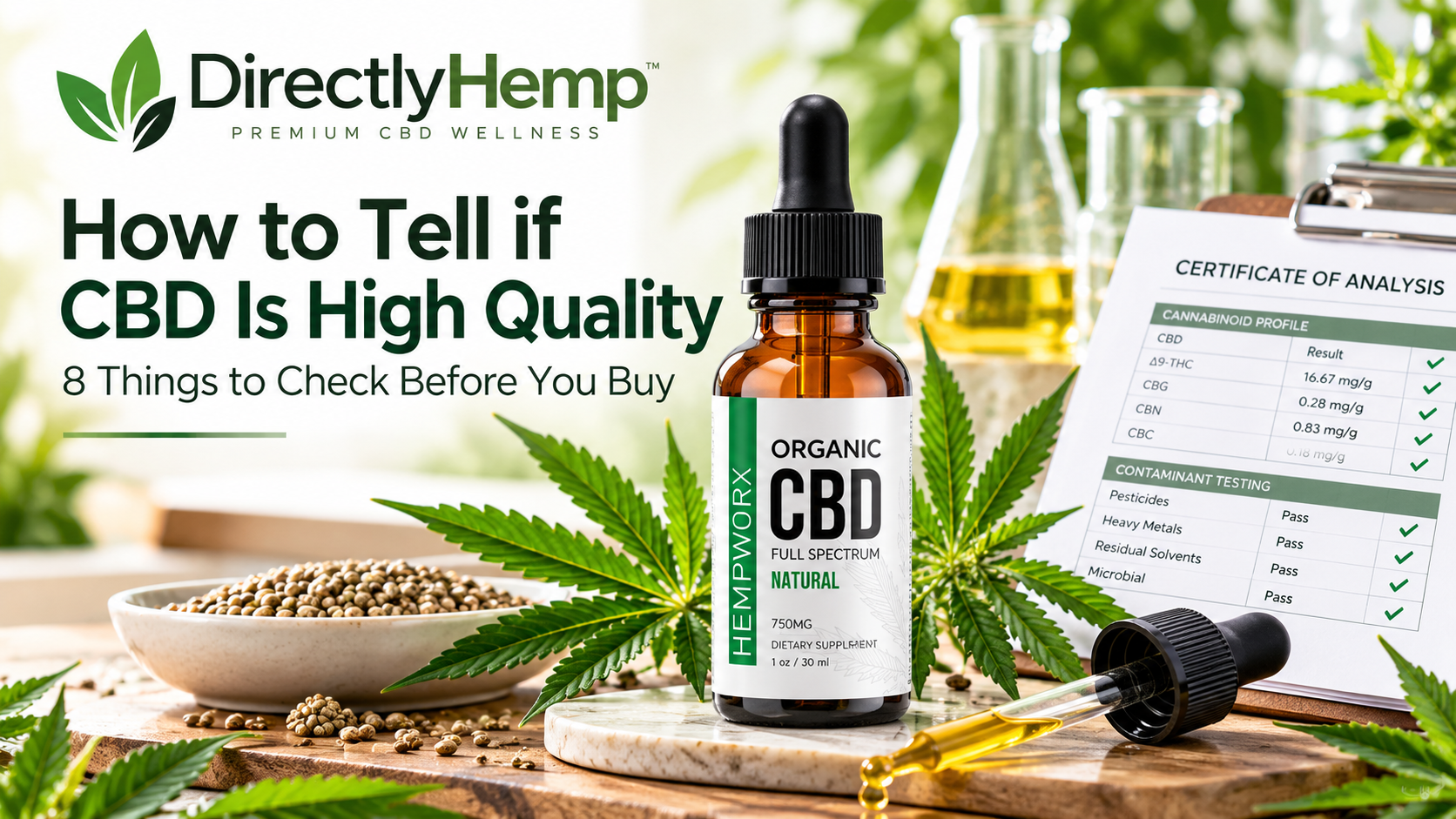
A Certificate of Analysis is a laboratory report showing what was detected in a particular CBD product or production batch.
A useful COA should come from an independent laboratory rather than simply repeating information supplied by the manufacturer.
Depending on the laboratory and product, the report may show:
- CBD concentration
- THC concentration
- other cannabinoids
- pesticides
- heavy metals
- residual solvents
- microbial contaminants
The presence of a COA does not automatically make a product high quality, but the absence of meaningful testing should make you ask more questions.
A reputable CBD seller should make testing information reasonably easy for customers to locate or request.
2. Make Sure the Lab Report Matches the Product
Finding a laboratory report is only the first step.
Check whether the report actually belongs to the product you are considering.
Look for information such as:
- product name
- batch or lot number
- testing date
- sample identification
- cannabinoid concentration
- laboratory name
If the bottle contains a lot or batch number, compare it with the number on the COA when possible.
A report from an unrelated product or an old batch tells you much less about the bottle you are purchasing today.
3. Compare the CBD Amount With the Label
If a bottle says it contains a certain amount of CBD, the cannabinoid analysis should reasonably support that claim.
For example, if a product is marketed as containing CBD, the laboratory report should show measurable CBD at a level reasonably consistent with the product description.
You do not need to be a chemist to perform a basic check.
Look at:
What the bottle claims
versus
What the laboratory measured
Large unexplained differences deserve further investigation.
This is also why shopping based solely on the biggest number printed on the front of a bottle can be misleading.
4. Check the THC Results
CBD and THC are different cannabinoids.
CBD is generally described as nonintoxicating, while THC is the cannabinoid most associated with the intoxicating effects of cannabis.
Full spectrum hemp products may contain small amounts of THC.
Broad spectrum products are generally produced to retain multiple hemp compounds while removing or reducing THC to nondetectable levels according to the manufacturer's testing standards.
If avoiding THC is important to you, do not rely solely on the words THC Free printed on the front.
Check the current product information and available laboratory report.
This is especially important for people subject to workplace or athletic drug testing.
No CBD or hemp product can guarantee that a person will pass a drug test.
5. Check for Contaminant Testing
Cannabinoid potency is only part of the story.
A more useful laboratory report may also test for unwanted contaminants.
Depending on the product and laboratory, look for sections covering:
Heavy Metals
These may include substances such as lead, arsenic, cadmium and mercury.
Pesticides
Hemp is an agricultural crop, so pesticide testing can provide useful information about what may remain after cultivation and processing.
Residual Solvents
Some extraction and manufacturing methods can involve solvents. Testing can help determine whether unwanted residues remain in the finished product.
Microbial Contaminants
Certain laboratory panels also screen for yeast, mold, bacteria or other microbiological contaminants.
Not every COA contains every testing category, so look carefully at what was actually tested rather than assuming a laboratory logo means everything was covered.
6. Find Out Where the Hemp Comes From
The source of the hemp matters because cultivation practices, growing conditions and manufacturing oversight can vary.
Look for a company that provides meaningful information about where its hemp is grown and how its products are made.
Useful details can include:
- country of origin
- growing region
- farming practices
- whether the hemp is genetically modified
- extraction method
- manufacturing standards
Be cautious with vague language such as premium hemp or highest quality hemp when no supporting information is provided.
Marketing language is not the same thing as documentation.
7. Read the Full Ingredient List
CBD products often contain more than hemp extract.
CBD oils may include a carrier oil and flavoring.
Gummies may contain sweeteners, colors, acids and other ingredients.
Topicals may contain menthol, botanical extracts, fragrances or skin conditioning ingredients.
Always read the complete ingredient list rather than focusing only on the CBD content.
Pay particular attention if you:
- have allergies
- avoid certain sweeteners
- follow a specific diet
- are sensitive to fragrances
- take medications
- are buying a product for a pet
A simple ingredient list is not automatically better, but consumers should know what they are taking or applying.
8. Be Cautious With Extreme Health Claims
One of the easiest ways to judge a CBD seller is to look at what it promises.
CBD products sold as consumer hemp products should not be marketed as guaranteed cures or treatments for serious diseases.
Be cautious with claims suggesting a product can:
- cure cancer
- replace prescription medication
- permanently eliminate chronic disease
- guarantee weight loss
- guarantee relief from a medical condition
- prevent serious illness
Consumer CBD products are not approved by the FDA to diagnose, treat, cure or prevent disease.
The FDA has approved one prescription cannabidiol medication for specific medical uses, but that is different from the CBD products sold as consumer hemp products.
A responsible seller should distinguish between general wellness information, customer experiences and medically established claims.
What Is a CBD COA?
COA stands for Certificate of Analysis.
Think of it as a laboratory snapshot of a particular sample.
A CBD COA can help answer questions such as:
- How much CBD was measured?
- Was THC detected?
- What other cannabinoids were present?
- Were contaminants tested?
- When was the sample analyzed?
- Which laboratory performed the testing?
The exact format varies by laboratory.
Some reports are very easy to read. Others contain tables, abbreviations and scientific units that can look intimidating at first.
The most important thing is to compare the report with the actual product rather than simply seeing the words lab tested and assuming everything checks out.
Full Spectrum vs Broad Spectrum: Does One Mean Better Quality?
No.
Full spectrum and broad spectrum describe different cannabinoid profiles. They do not automatically indicate whether a product is good or bad.
Full Spectrum
Full spectrum hemp extract generally contains CBD along with other naturally occurring hemp cannabinoids and may contain legally permitted levels of THC.
Broad Spectrum
Broad spectrum hemp extract generally retains multiple cannabinoids while being processed to remove THC or reduce it to nondetectable levels according to testing.
The better choice depends on what you are looking for.
Someone who specifically wants to avoid detectable THC may prefer a broad spectrum product.
Someone who prefers the wider naturally occurring cannabinoid profile may choose full spectrum.
You can read our complete comparison in the Directly Hemp guide to Full Spectrum vs Broad Spectrum CBD.
Does Organic CBD Automatically Mean Better CBD?
Not necessarily.
Organic certification or organic agricultural practices can be useful information, but the word organic does not replace:
- laboratory testing
- accurate cannabinoid labeling
- contaminant screening
- proper manufacturing
- ingredient transparency
Think of organic sourcing as one factor rather than the entire quality test.
Does Expensive CBD Mean Better Quality?
No.
Price alone tells you very little.
A more expensive product may use higher quality ingredients or more extensive testing, but price can also reflect branding, packaging, distribution and marketing.
A cheaper product may represent good value if the potency, ingredients and testing are transparent.
Compare:
- CBD amount
- product size
- price per serving
- price per milligram of CBD
- testing
- ingredients
- return policy
That gives you a more useful comparison than price alone.
How HempWorx Products Compare
Directly Hemp sells HempWorx products, so this section is not presented as an independent review.
We believe shoppers should evaluate HempWorx using the same criteria described above rather than giving the brand a free pass simply because we sell it.
The current HempWorx range available through Directly Hemp includes full spectrum CBD oils, broad spectrum THC free CBD oils, gummies, topical products and pet products.
When comparing HempWorx with another CBD brand, look at:
Spectrum
HempWorx offers both full spectrum and broad spectrum options, allowing shoppers to choose based on whether they prefer a complete cannabinoid profile or a product described as having no detectable THC.
Product Information
Review the current product label for cannabinoid strength, ingredients, serving information and directions.
Testing
Look for current testing information for the specific product and batch whenever available.
Ingredients
Do not assume every HempWorx product has the same formula. An oil, gummy, cream and pet tincture can contain very different supporting ingredients.
Price
Compare the actual CBD content and serving size rather than simply comparing bottle prices.
You can browse the current HempWorx catalog on Directly Hemp and compare full spectrum oils, broad spectrum oils, gummies, topicals and other formats side by side.
A Simple CBD Quality Checklist
Before buying CBD, ask:
Does the product clearly state how much CBD it contains?
Can I find a recent COA or laboratory report?
Does the report match the product or batch?
Does the measured CBD reasonably match the label?
Does the report show THC results?
Was the product tested for contaminants?
Can I identify where the hemp came from?
Is the ingredient list complete?
Does the company avoid unrealistic medical claims?
Can I easily find contact, return and company information?
If several of those questions cannot be answered, keep looking.
What Are Red Flags When Buying CBD?
Common warning signs include:
- no laboratory testing information
- no identifiable manufacturer or seller
- missing ingredient list
- no cannabinoid amount on the label
- exaggerated disease treatment claims
- outdated laboratory reports
- lab reports that do not identify the product
- vague claims such as pharmaceutical grade without explanation
- confusing use of hemp seed oil and CBD as though they are the same thing
- no return, shipping or contact information
None of these automatically proves a product is unsafe, but multiple red flags should make a shopper cautious.
Where Should You Buy CBD?
The safest approach is to buy from a seller that gives you enough information to make an informed comparison.
Before ordering, look for:
- clear product descriptions
- current pricing
- ingredients
- cannabinoid strength
- testing information
- shipping information
- return policies
- company contact information
Directly Hemp carries the current HempWorx product range and provides product information intended to help shoppers compare formats rather than simply choosing the most expensive option.
Frequently Asked Questions
How can you tell if CBD is high quality?
Look for independent laboratory testing, clear cannabinoid strength, THC results, contaminant testing, transparent ingredients, hemp sourcing information and realistic marketing claims.
What should a CBD lab report show?
A useful CBD lab report may show CBD and THC concentrations, other cannabinoids, test date, batch information and testing for contaminants such as pesticides, heavy metals, solvents or microorganisms.
What does COA mean on CBD?
COA means Certificate of Analysis. It is a laboratory report showing what was detected in a tested sample.
Is full spectrum CBD higher quality than broad spectrum CBD?
No. They are different formulations. Quality depends more on testing, manufacturing, ingredients and accurate labeling than on whether the product is full or broad spectrum.
Should CBD contain THC?
Full spectrum hemp products may contain small amounts of THC within applicable legal limits. Broad spectrum products are generally formulated to remove THC or reduce it to nondetectable levels according to testing.
Can CBD make you fail a drug test?
Some CBD products, especially full spectrum products, can expose a person to THC. No CBD seller should guarantee that a product will produce a particular drug test result.
Is expensive CBD always better?
No. Compare CBD content, testing, ingredients, serving size, price per milligram and company transparency rather than assuming higher price means higher quality.
Is hemp seed oil the same as CBD oil?
No. Hemp seed oil is pressed from hemp seeds and generally contains little or no CBD. CBD oil contains cannabinoid rich hemp extract combined with a carrier oil.
Bottom Line
Good CBD should not require blind trust.
The label, laboratory report, ingredients and company information should give you enough detail to understand what you are buying.
Start with the COA, compare it with the product label, check the THC and contaminant results, read the ingredients and be skeptical of claims that sound too good to be true.
The best CBD product is not necessarily the one with the loudest packaging or the highest price.
It is the one that gives you enough reliable information to make an informed decision.
Keep reading on our site
Disclosure: Directly Hemp sells HempWorx products. Product comparisons and educational information on this website are provided to help consumers evaluate available options and should not be interpreted as independent third party reviews. Health Notice: This article is educational and is not medical advice. Consumer CBD and hemp products are not intended to diagnose, treat, cure or prevent disease. Speak with a qualified healthcare professional before using CBD if you take medication, are pregnant or breastfeeding, have a medical condition or have questions about whether CBD is appropriate for you.