
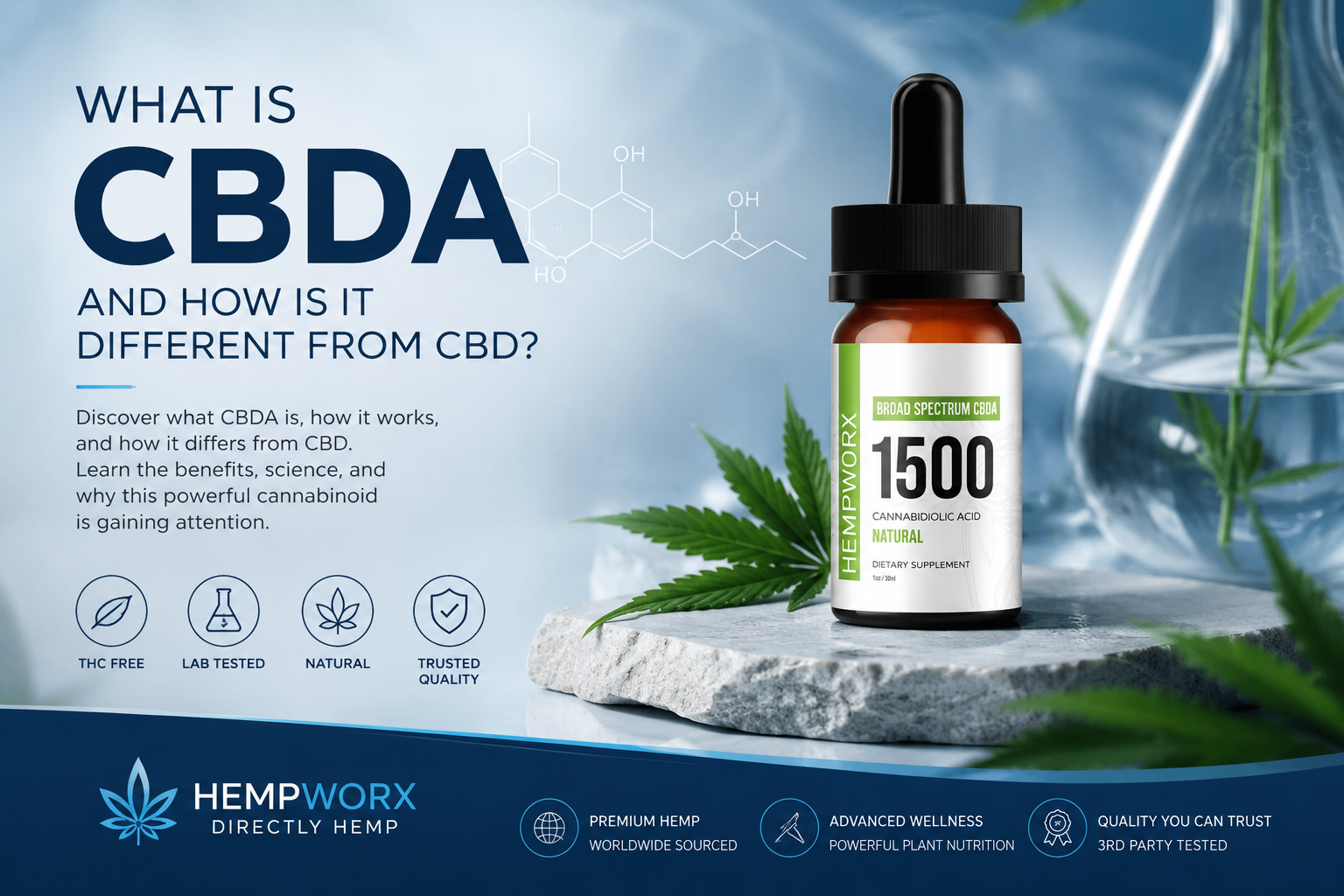
- CBDa vs CBD
- raw cannabinoids
- HempWorx CBD oil
- full spectrum CBD
- HempWorx
CBDa is not a competitor to CBD, it is its earlier form. Understanding how one becomes the other explains why raw hemp and finished CBD oil behave differently.
CBDa is the raw acid version of CBD
In a living hemp plant there is almost no CBD at all. What the plant actually produces is cannabidiolic acid, written as CBDa. It is the acidic precursor that sits in the fresh flowers and leaves while the crop is still growing in the field.
CBD appears later, once that acid loses a carbon dioxide molecule. Chemists call the process decarboxylation, and it happens with time, light and above all heat. So CBDa and CBD are the same family, separated by one step.
How heat turns CBDa into CBD
Drying and curing harvested hemp starts the conversion slowly. Gentle warming during extraction finishes it. That is why nearly every finished tincture on the shelf, including HempWorx CBD oil, is measured in CBD rather than CBDa.
Raw juiced hemp, unheated fresh leaf and a few cold pressed products keep more of the acid form intact. Once a product has been warmed, most of the CBDa in it has already become CBD, so a label promising both usually reflects a partial conversion.
Do they act differently in the body
Early laboratory research suggests the two interact with the body along different paths. CBD is studied for its effect on the endocannabinoid system and on receptors linked with calm, sleep and discomfort. CBDa appears to be more active on enzymes tied to inflammation signaling, and some studies note stronger binding at certain serotonin receptors.
The honest summary is that CBD has years of human research behind it while CBDa research is still young and mostly preclinical. Neither is a medicine, and neither replaces advice from your doctor.
Which one is easier to actually get
CBD is far more available, better standardized and easier to dose because manufacturers can verify milligrams per bottle in a lab. CBDa is fragile, converts on its own over time, and loses potency when a bottle sits in a warm cupboard.
For anyone who wants a repeatable daily routine, a lab tested CBD oil is the practical pick. Full spectrum bottles naturally carry small amounts of other cannabinoids from the plant, which can include residual CBDa.
Full spectrum keeps more of the plant in the bottle
Full spectrum extract retains the wider range of cannabinoids and terpenes the plant produced, with trace THC held under the legal 0.3 percent limit. Broad spectrum, often labeled THC free, removes detectable THC while keeping other plant compounds.
HempWorx CBD oil comes in both full spectrum and THC free in matching strengths, and broad spectrum is described by current product information as having no detectable THC. No hemp or CBD product can guarantee a particular drug test result.
How to choose your first bottle
Start with a 750 mg bottle, take it at the same time daily, and give it a week before judging. Compare products by price per milligram rather than bottle size, and always check that a third party lab report backs the number on the label.
If your concern is a specific knee, shoulder or lower back, a topical applied straight to the area is often the more direct route than raising an oral dose.
A word of caution
These statements have not been evaluated by the Food and Drug Administration. These products are not intended to diagnose, treat, cure or prevent any disease. Talk with your doctor before starting CBD or CBDa, especially if you are pregnant, nursing or taking prescription medication.
Keep reading on our site
Sources and further reading
These statements have not been evaluated by the Food and Drug Administration. These products are not intended to diagnose, treat, cure or prevent any disease.