
- CBG vs CBD
- what is CBG
- cannabinoids
- HempWorx Relief Cream
- hemp education
What is CBG, and how is it different from CBD? Compare the two non intoxicating hemp cannabinoids, learn why CBG is getting attention in 2026, and see why some products combine CBD and CBG.
What is CBD?
CBD stands for cannabidiol. It is one of the major cannabinoids naturally produced by Cannabis sativa, including hemp varieties. CBD has become the dominant non intoxicating cannabinoid in consumer hemp products, which is why you now see it in CBD oils and tinctures, gummies, topical creams, capsules and sprays, and pet specific products.
CBD has also received considerably more scientific attention than minor cannabinoids such as CBG. A 2025 pharmacokinetic review comparing CBD, CBG and several other cannabinoids described CBD as the most extensively studied of the group. That larger research base is one reason CBD remains the starting point for most people exploring hemp derived cannabinoid products.
What is CBG?
CBG stands for cannabigerol. It occurs naturally in hemp, but typically in smaller concentrations than CBD. You will sometimes hear CBG referred to as the mother cannabinoid, though that description is a little oversimplified.
Technically, CBGA, or cannabigerolic acid, is the important precursor molecule. During the plant's development, CBGA can be converted into acidic precursors that eventually become cannabinoids including CBD and THC. CBG itself can form when CBGA is decarboxylated. Because much of the plant's CBGA is converted into other cannabinoids as it matures, comparatively little CBG may remain. That relative scarcity helps explain why dedicated CBG products can sometimes cost more than standard CBD products.
CBG vs. CBD: what's the main difference?
Both come from hemp, but chemically they are different cannabinoids. One major difference is simply how much scientific evidence we have. CBD has years of extensive research behind it. CBG research is growing quickly, but recent scientific reviews continue to point out that clinical evidence in humans remains much more limited. A 2025 review concluded that additional research is particularly necessary for CBG and other minor cannabinoids, especially human clinical studies.
That distinction is important. You may see online advertisements claiming CBG is dramatically stronger than CBD or treating it as a cure for particular conditions. Current research does not justify those kinds of blanket claims. CBG is interesting. It is not magic.
Does CBG get you high?
CBG is generally classified as a non intoxicating cannabinoid, and CBD is non intoxicating as well. That separates both cannabinoids from THC, which is primarily responsible for the high associated with marijuana.
However, the cannabinoid listed on the front of a product does not tell you everything inside the bottle. A full spectrum CBD or CBG product may contain other naturally occurring cannabinoids, including legally permitted trace amounts of THC. If avoiding THC matters because of employment testing or another reason, check the actual cannabinoid profile and third party lab information rather than assuming every CBD or CBG product is THC free.
How do CBD and CBG work differently?
Both compounds interact with complex signaling systems in the body, but researchers have found differences in their molecular activity. CBD tends to influence the endocannabinoid system more indirectly and interacts with several biological targets. CBG appears to interact differently with cannabinoid receptors and additional molecular targets, including alpha 2 adrenergic receptors and certain serotonin and TRP pathways.
That does not mean one is automatically stronger or better. It means they are separate molecules with different pharmacological profiles. A recent 2026 scientific review described CBG and CBGA as emerging cannabinoids of interest while also emphasizing the need for continued translational and clinical research.
Is CBG better than CBD?
There is no scientifically defensible answer that says CBG is universally better than CBD. Think of the comparison more like this: CBD is more established, more widely available and substantially more researched. CBG is less abundant, less studied and increasingly used either alone or alongside CBD.
The better choice depends on the formulation you are considering rather than simply choosing the cannabinoid with the newest name. When comparing products, look at the cannabinoid amount and how much CBD or CBG is actually present, the product format such as an oral tincture, gummy or topical, the spectrum such as full spectrum, broad spectrum or isolate, third party testing that verifies what is inside, and other ingredients. Menthol, botanicals, carrier oils and flavorings can significantly change the product experience.
Why do some products combine CBD and CBG?
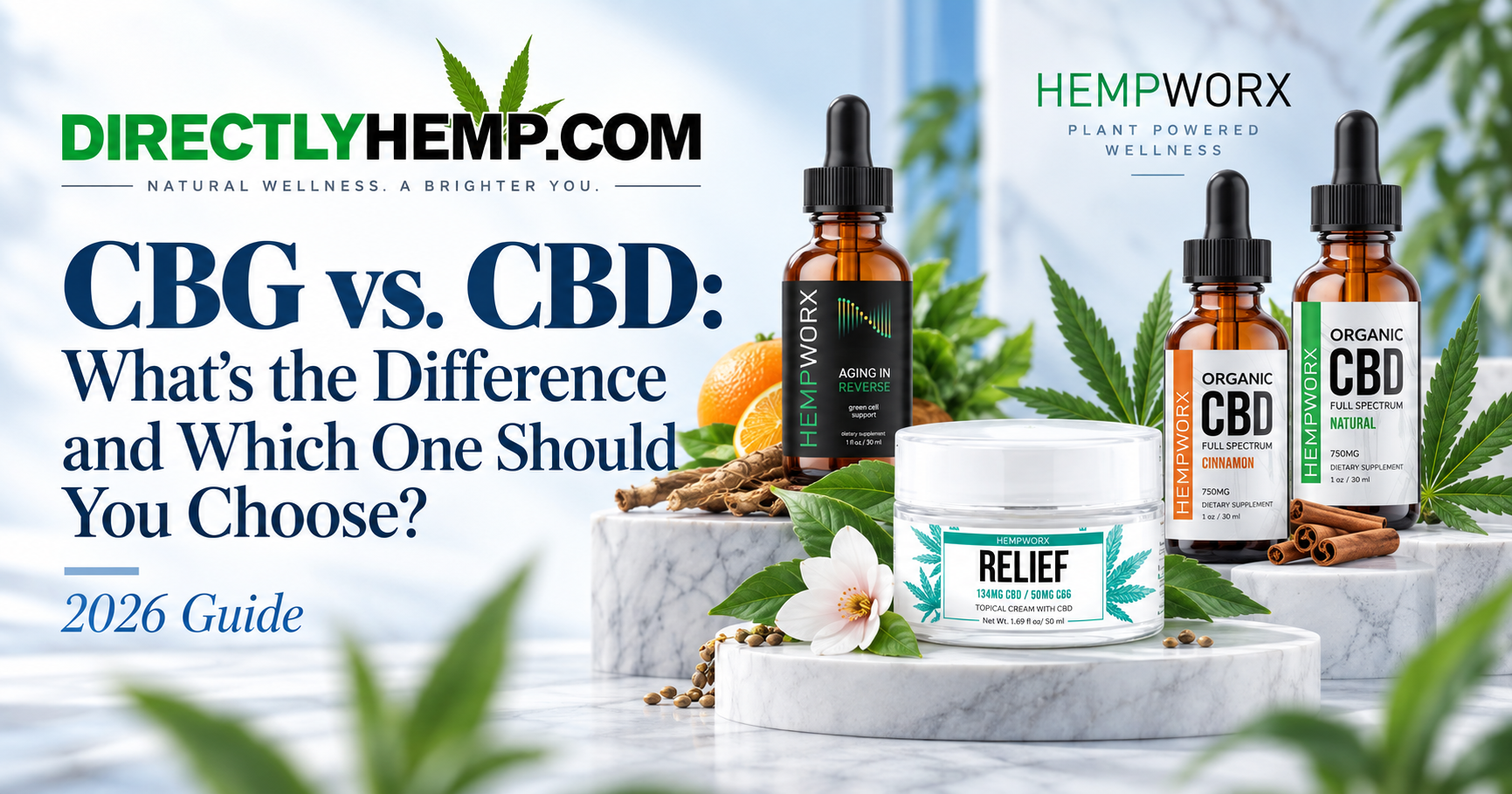
This is where CBG becomes particularly relevant to HempWorx customers. Some formulations combine cannabinoids instead of relying on CBD alone. The current HempWorx Relief Cream, for example, includes both hemp derived CBD and CBG as part of the topical formula, along with menthol and skin conditioning ingredients.
That does not mean the combination is proven to treat a particular medical condition. It simply means the formulation intentionally includes more than one hemp derived cannabinoid. This is also why it is worth reading an entire product label rather than looking only for the largest CBD number.
CBD vs. CBG for topical products
CBG is increasingly appearing in topical hemp formulations. Topicals are fundamentally different from tinctures because they are designed to be applied externally to a specific area rather than swallowed.
For a product like HempWorx Relief Cream, the experience also comes from ingredients beyond the cannabinoids. Its current formulation includes menthol, which produces the noticeable cooling sensation customers associate with the product. That distinction matters when comparing brands. If one cream contains CBD alone and another contains CBD, CBG and menthol, you are not making an apples to apples comparison based solely on the number of milligrams.
Can you use CBD and CBG together?
Products containing both cannabinoids already exist, so CBD and CBG are not inherently mutually exclusive. What matters is the overall formulation and your total cannabinoid exposure. CBD and CBG can also be metabolized differently depending on dose, delivery method, formulation and food intake. Scientific researchers have found considerable pharmacokinetic variability with non intoxicating cannabinoids.
If you take prescription medications, have a medical condition, are pregnant or nursing, or are considering substantial cannabinoid use, discuss it with a qualified healthcare professional rather than assuming that plant derived means interaction free.
Does CBG show up on a drug test?
Standard marijuana drug testing generally focuses on THC and its metabolites, not CBG itself. The more important question is whether the product containing CBG also contains THC. A full spectrum formulation may contain trace THC. A broad spectrum or THC free formulation is designed differently.
If workplace or legal testing is important to you, examine the Certificate of Analysis and cannabinoid profile of the actual product. You can also read our CBD and drug testing guide and full spectrum vs broad spectrum CBD guide at Directly Hemp for a more detailed explanation.
CBD, CBG and the importance of lab testing
Minor cannabinoids are another reason third party testing matters. A study analyzing commercially available, unregulated CBD products found CBG in 77% of the samples tested, demonstrating that minor cannabinoids can be present even when CBD is the product's headline ingredient.
A good cannabinoid lab report can help identify CBD content, CBG content, THC content, other detectable cannabinoids, product potency and certain contaminant testing. Do not assume two bottles labeled hemp extract contain the same cannabinoid profile.
Should you choose CBD or CBG?
For most beginners, CBD remains the easier place to start. It is more widely researched, available in many strengths and formats, and easier to compare between products. CBG becomes particularly interesting when you are examining a formulation that intentionally combines it with CBD, which is exactly the situation with products such as HempWorx Relief Cream.
Rather than thinking CBD vs CBG, which one wins, a more useful question is: what cannabinoids are in this particular product, in what amounts, and why were they included? That approach makes comparing hemp products considerably easier.
Frequently asked questions about CBG vs CBD
What does CBG stand for? CBG stands for cannabigerol, a naturally occurring cannabinoid found in cannabis and hemp.
Is CBG the same as CBD? No. Cannabigerol and cannabidiol are separate cannabinoids with different chemical structures and biological activity.
Is CBG stronger than CBD? There is no universal scientific measure showing that CBG is stronger than CBD. CBD is much more extensively studied, while CBG research is still developing.
Does CBG contain THC? CBG itself is not THC. However, a finished hemp product containing CBG may also contain THC depending on how it is formulated. Check the product's cannabinoid analysis.
Can CBD and CBG be in the same product? Yes. Some hemp products intentionally combine CBD and CBG. HempWorx Relief Cream is one example currently sold through Directly Hemp.
Is CBG intoxicating? Current literature generally describes CBG as non intoxicating.
The bottom line
CBG and CBD are related, but they are not the same cannabinoid. CBD is more abundant in most commercial hemp products and has been studied far more extensively. CBG is a minor cannabinoid receiving increasing attention, partly because of its distinct molecular activity and partly because manufacturers are beginning to include it alongside CBD in multi cannabinoid products.
The science surrounding CBG is promising enough to justify research, but still developing enough that exaggerated health claims should be treated cautiously. For consumers, the smartest approach is straightforward: know which cannabinoids are in the product, understand whether it is full spectrum or THC free, check the potency and third party testing, and choose the formulation rather than chasing whichever cannabinoid happens to be trending.
You can explore HempWorx CBD Oil, CBD plus CBG Relief Cream and other HempWorx products through the Directly Hemp Learning Center.
Keep reading on our site
Sources and further reading
This article is for general educational purposes and is not medical advice. Directly Hemp is an authorized seller of HempWorx products. These statements have not been evaluated by the Food and Drug Administration. These products are not intended to diagnose, treat, cure or prevent any disease. Consult a qualified healthcare professional if you have questions about cannabinoid use, especially if you take prescription medication.